Dental Hygiene Credentialing: A Roadmap for Post-License Education and Professional Standards
Aug 12, 2026Standardized naming conventions for dental hygiene credentialing provide a shared framework for educators, employers, and clinicians to evaluate professional achievements and workforce development pathways.
As dental hygienists increasingly integrate into multidisciplinary healthcare settings as oral health experts, they interact with credentialing systems common to other health professions. Aligning dental hygiene with these broader frameworks ensures accurate communication of qualifications and professional credibility in hospital and medical settings.
Post-license credentials are fundamentally divided into two categories: education and certification. While education-based credentials signify that a student has completed specific course content, professional certification independently validates practice competence through a standardized assessment separate from the training itself. It is critical to distinguish these: describing a learner as "certified" solely based on finishing an educational course is inaccurate.
Among the four categories below, only number four, a state-issued authorization, may expand a licensed professional’s legal scope of practice or permit a specific clinical function.
EDUCATION
1. Participation-Based Education (CE Credit)
Continuing education (CE) typically consists of short, stand-alone courses designed to communicate evidence-based research, update outdated knowledge and maintain licensure. These courses result in a certificate of attendance or participation.
Participation-based courses document attendance rather than mastery and do not constitute comprehensive evidence of advanced or comprehensive specialty education.
AGD PACE, ADA CERP, and AADH are three bodies that publish dental CE guidelines. They do not accredit each course or verify every learner’s competence; they simply approve or recognize CE providers.1–3 Provider approval is not program accreditation. AGD PACE and ADA CERP state specifically in their guidelines that the term accreditation is not to be used when referring to educational activities.
In medical CME, the ACCME accredits organizations to provide CME rather than individual activities. Similarly, dental CE recognition applies to the provider, not the specific course.4
2. Assessment-Based Education (Training or Certificate Programs)
Assessment-based education programs are structured training initiatives designed to address defined skill gaps and support advanced workforce development. They may range from a short intensive program that is stackable, to a multi-module course and include an assessment that measures whether the learner achieved the intended learning outcomes.
Unlike professional certification, a certificate-program assessment evaluates mastery of the educational content taught in that program. It is not an independent assessment of current professional competence across a practice area. Successful completion results in an educational credential documenting completion of a defined curriculum and assessment. In emerging practice areas, a comprehensive certificate program may also award an educational designation, such as Certificate Holder in Oral-Systemic Education (CH-OSE).
Key characteristics include:
- Education is designed based on a needs assessment to close specific, targeted workforce gaps in expanding fields.
- Assessment measures whether those outcomes were achieved.
- Certificates are a permanent part of the learner's educational record, like a college course or degree.
- Most have a lifetime term, but issuing organizations can set a specific term if warranted.
- Completion does not independently expand a licensed professional’s legal scope of practice.
- Education may support eligibility for a professional certification or state-based license endorsement.
High-quality, credible certificate programs use a systematic process that includes gap analysis, an instructional-design plan, curriculum mapping, valid assessments, and program evaluation. Common instructional-design models include ADDIE, Backward Design, the Dick and Carey Systems Approach, and the Kemp Model.
Programs may pursue independent, third-party accreditation through two pathways:
- The ANSI National Accreditation Board’s (ANAB) Certificate Accreditation Program, which assesses programs against the ASTM E2659 standard for assessment-based certificate program accreditation.
- The Institute for Credentialing Excellence’s (ICE) Assessment-Based Certificate Accreditation Program, which uses the ICE 1100 Standard.
These standards require programs to document a generally accepted approach that aligns learner needs, learning outcomes, content, delivery methods, assessments, and ongoing evaluation.⁵˒⁶ Accreditation can take years and may require more than one development cycle to meet rigorous quality standards.
These external auditors address a quality-assurance need in advanced dental-hygiene education, because CODA accredits entry-level and degree-granting programs rather than post-licensure training.⁷ Depending on the program and applicable requirements, accredited assessment-based education may also be accepted for academic credit, meet a prerequisite for an expanded function, or qualify for certain education-savings funding like 529 plans.
CERTIFICATION
3. Board or Professional Certification (Certified)
Professional certification independently evaluates whether an individual meets defined competency requirements through a rigorous, psychometrically defensible process. It is not awarded simply because a learner completed a course.
A credible certification operates under a documented certification scheme. A certification scheme is the complete set of published rules behind one specific credential. It defines the scope of practice or competence being assessed, eligibility requirements, assessment methods, certification decisions, maintenance requirements, and conditions for suspension or withdrawal.
The organization responsible for operating the certification scheme is called the certification body. Its governance structure—often a board of directors or certification board—must protect the impartiality and autonomy of certification decisions. The board provides oversight to ensure that certification decisions are fair, consistent, and based on the published requirements of the scheme. A professional may be described as board certified when they have earned a credential awarded by that certification board. There is currently no independent board or professional certification specifically for the dental hygiene profession. A credible certification is not earned solely by completing a course sold by the individual or organization that awards the credential.
The foundation of a high-quality certification program is a Job Task Analysis (JTA), sometimes called a practice analysis. A JTA is a systematic study of current professional practice. It identifies the duties, knowledge, skills, and clinical judgments required in the field, ensuring that examination content reflects real-world professional responsibilities.
Professional certification must be completely separate from completing an educational course and from state-issued authorization (#4 in this list). It validates competence against established standards; it does not, by itself, expand a licensee’s legal scope of practice.
- Organizational Impartiality: Certification decisions must be protected from educational, financial, or commercial interests that could influence who earns the credential. A credible certification maintains a clear firewall between certification and education. Earning certification (becoming “certified”) cannot be contingent on completing a specific course, learning activity, or training program offered or required by the certifying person or organization. Candidates must have fair, independent pathways to demonstrate competence.⁹
- Psychometric Rigor: A professional-certification examination is not based on an individual course and cannot be limited to what one instructor or organization teaches. It is based on a current Job Task Analysis and an exam blueprint tied to real professional duties and competencies. Qualified experts develop and review questions, and item analysis evaluates question quality, fairness, and performance. When multiple exam forms are used, form analysis helps ensure comparable difficulty across versions. Passing scores are established through a documented, defensible process—such as the Angoff method—not chosen arbitrarily.
- Ongoing Competence: Certification is not permanent. For example, physicians who are board-certified in Internal Medicine through the American Board of Internal Medicine (ABIM) must meet ongoing certification requirements to maintain their credential.¹⁰ Credible certification programs similarly require periodic recertification through proof of continued practice, continuing education, reassessment, or other defined requirements.
- Accreditation: Credible certification bodies use published standards to guide the development of their certification schemes. It may take years for an organization or board to collect sufficient data to pursue accreditation, as the process is costly and may require multiple iterations to meet the quality standards required. Certification programs may seek independent accreditation through two distinct pathways:
1. NCCA accreditation: The NCCA accredits individual certification programs under the NCCA Standards for the Accreditation of Certification Programs. Each certification program must be independently reviewed and accredited.¹¹
2. ISO/IEC 17024 accreditation: An accreditation body, such as ANAB, accredits the organization operating certification-of-persons schemes to ISO/IEC 17024. That accreditation applies only to the certification scheme(s) included within the organization’s approved scope; it does not automatically extend to every credential the organization offers.¹²
Case Study 1: International Association of Orofacial Myology (IAOM)
The International Association of Orofacial Myology offers the Certified Orofacial Myologist (COM®) credential.¹³ Rather than requiring applicants to complete education offered by IAOM or any one named provider, IAOM permits applicants to complete any single introductory orofacial myofunctional therapy course of at least 28 hours. Candidates must then complete a written proficiency examination and a proctored onsite evaluation.¹³ IAOM is pursuing accreditation of its COM® certification program through the National Commission for Certifying Agencies (NCCA) under the NCCA Standards for the Accreditation of Certification Programs. This voluntary pursuit of independent accreditation reflects IAOM’s commitment to transparent, published standards and rigorous quality assurance.
Case Study 2: American Association of Critical-Care Nurses (AACN)
The American Association of Critical-Care Nurses (AACN) provides a gold-standard model for maintaining a credible firewall between education and certification. AACN houses its educational and certification functions in entirely separate operational arms, each with distinct boards of directors and independent staff. This structural separation ensures the certification process functions as a neutral, objective validation of clinical competence, entirely insulated from the commercial interests of educational review offerings.¹⁴ The AACN Certification Corporation further validates this rigor by maintaining accreditation from the Accreditation Board for Specialty Nursing Certification (ABSNC), ensuring their programs meet the highest standards of professional certification for their field.¹⁵
4. State-Issued Certification (Scope Expansion or Expanded Functions)
A state-issued certification is granted by a governing body for a defined function. State statutes and dental-board rules may instead call it a permit, endorsement, registration, certificate, designation, or authorization; the jurisdiction’s official legal term always controls. It is not education and does not award CE, although qualifying education and proof of competency is typically required for application.
Scope of practice varies widely with state-issued certifications. One example is a certification for local anesthesia, especially for those who did not learn while in dental hygiene school. It requires assessment-based education (certificate program) followed by a formal application to the state board. As it is clinical in nature, there is also a hands-on component required for patient safety. The educational certificate is a prerequisite for the license endorsement.
Other examples include public health, laser, restorative, and alternative practice designations. Requirements are defined by individual state legislatures and dental practice acts.
While civilian dental hygienists must strictly adhere to the specific dental practice act of the state where they work, 10 U.S. Code § 1094 exempts military and federal healthcare providers from local state-based restrictions. This federal preemption allows an RDH holding any valid U.S. state license to practice under a uniform, standardized scope dictated entirely by the Department of Defense, regardless of the state in which they are stationed.¹⁶
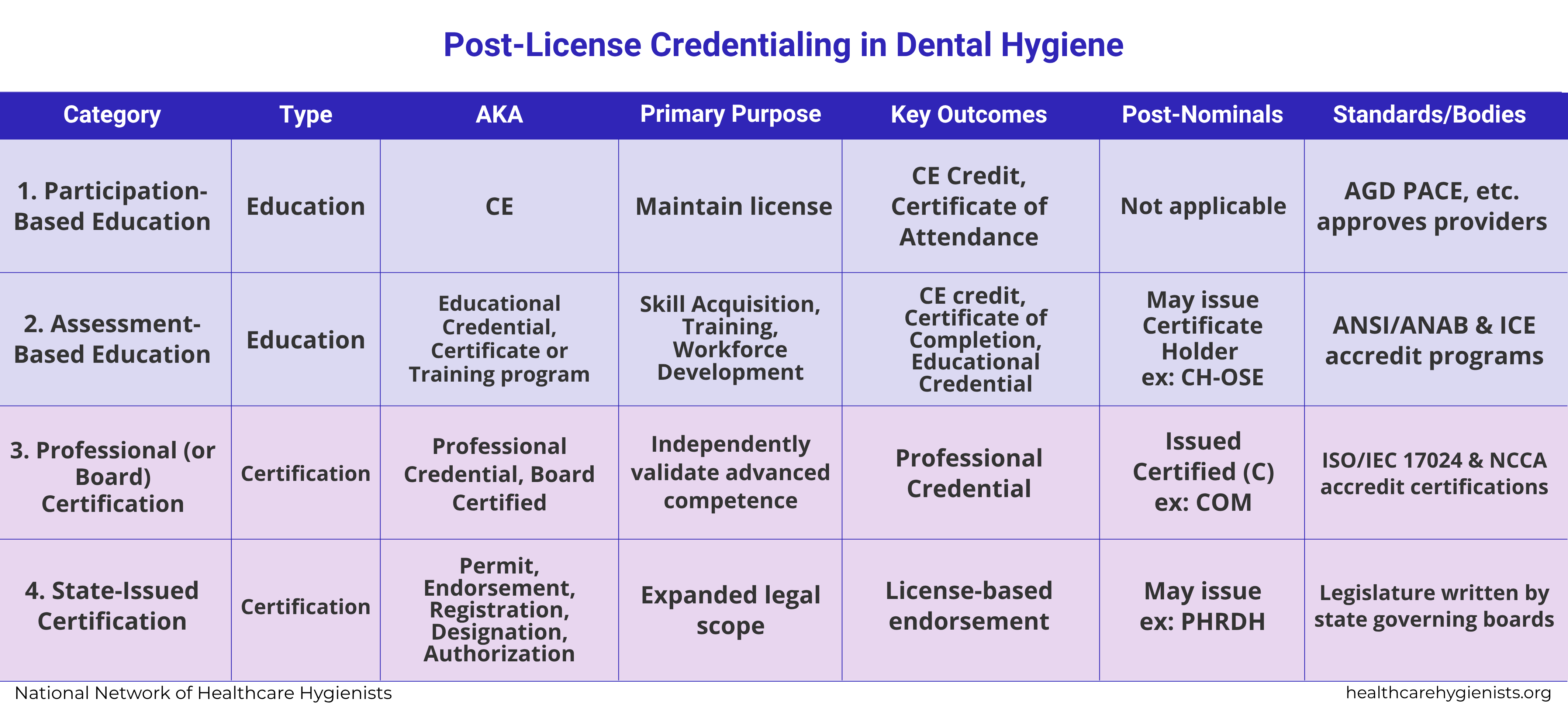
Download the map & article highlights HERE
CLOSING
Standardizing this vocabulary is more than a matter of semantics; it is a vital step toward advancing the professionalization of dental hygiene. By clearly distinguishing between educational training and independent certification, educators, developers, and practitioners can align their goals with the broader standards of healthcare. Embracing these frameworks ensures that every achievement—from a specialized skill course to board certification—is recognized with the accuracy and respect it deserves. As the profession of dental hygiene continues to evolve, this commitment to precision will serve as a cornerstone for career advancement, interdisciplinary collaboration, and professional excellence.
Over the past eight years, I have studied post-licensure credentialing across other healthcare disciplines to help build the infrastructure necessary for the profession of dental hygiene to be recognized as a credible collaborative-care partner in hospital and medical settings. As my understanding continues to grow, I will update this article and share what I learn with you.
If you are an RDH working in a healthcare setting, please participate in this Job Task Analysis and share it with your peers.
AUTHOR

Jamie Dooley, BIS, RDH, CWDP
Jamie is the Program Director at the National Network of Healthcare Hygienists (NNHH), leading the movement to position dental hygienists as essential, high-impact members of interprofessional healthcare teams. With a background in dental public health, coaching, and workforce development, Jamie champions a vision where hygienists expand their professional identity as oral-systemic experts within the broader healthcare landscape. Under her leadership, NNHH launched the world's first ANSI-accredited certificate program for dental hygienists, establishing a global benchmark for post-licensure excellence. A recognized thought leader in medical-dental integration, Jamie is dedicated to empowering RDHs to bring their specialized expertise into diverse medical settings, transforming patient outcomes through collaborative, person-centered care.
References
- Academy of General Dentistry. PACE program guidelines [Internet]. Chicago (IL): Academy of General Dentistry; [cited 2026 Aug 11]. Available from: https://www.agd.org/education/learn/find-a-pace-provider/pace/pace-guidelines
- Commission for Continuing Education Provider Recognition. ADA CERP recognition process [Internet]. Chicago (IL): American Dental Association; [cited 2026 Aug 11]. Available from: https://ccepr.ada.org/recognition-process
- American Academy of Dental Hygiene. Become a continuing education provider [Internet]. [cited 2026 Aug 11]. Available from: https://www.aadh.org/become-a-ce-provider
- Accreditation Council for Continuing Medical Education. Expectations and eligibility [Internet]. Chicago (IL): ACCME; [cited 2026 Aug 12]. Available from: https://accme.org/about-accreditation/expectations-eligibility/
- ASTM International. ASTM E2659-24: Standard practice for certificate programs [Internet]. West Conshohocken (PA): ASTM International; [cited 2026 Sep 17]. Available from: https://www.astm.org/e2659-24.html
- ANSI National Accreditation Board. Certificate accreditation program under ANSI/ASTM E2659-24 [Internet]. Washington (DC): ANSI National Accreditation Board; [cited 2026 Sep 17]. Available from: https://anab.ansi.org/accreditation/certificate-program-ansi-astm-e2659-24/
- Institute for Credentialing Excellence. Assessment-Based Certificate Accreditation Program [Internet]. Washington (DC): Institute for Credentialing Excellence; [cited 2026 Sep 17]. Available from: https://www.credentialingexcellence.org/Accreditation/Earn-Accreditation/ACAP
- Commission on Dental Accreditation. Find a program: About programs accredited by CODA [Internet]. Chicago (IL): American Dental Association; [cited 2026 Aug 11]. Available from: https://coda.ada.org/find-a-program/
- National Commission for Certifying Agencies. NCCA frequently asked questions [Internet]. Washington (DC): Institute for Credentialing Excellence; [cited 2026 Sep 17]. Available from: https://www.credentialingexcellence.org/Accreditation/Earn-Accreditation/NCCA/FAQs
- American Board of Internal Medicine. Maintaining your certification [Internet]. Philadelphia (PA): American Board of Internal Medicine; [cited 2026 Sep 17]. Available from: https://www.abim.org/maintenance-of-certification/
- National Commission for Certifying Agencies. NCCA accreditation process for certification programs [Internet]. Washington (DC): Institute for Credentialing Excellence; [cited 2026 Sep 17]. Available from: https://www.credentialingexcellence.org/Accreditation/Earn-Accreditation/NCCA
- ANSI National Accreditation Board. Personnel certification under ISO/IEC 17024 [Internet]. Washington (DC): ANSI National Accreditation Board; [cited 2026 Sep 17]. Available from: https://anab.ansi.org/accreditation/personnel-certification/
- International Association of Orofacial Myology. IAOM candidate guide to Certified Orofacial Myologist® [Internet]. [cited 2026 Sep 17]. Available from: https://iaom.com/wp-content/uploads/2026/06/IAOM-Candidate-Guide-to-COM.pdf
- AACN Certification Corporation. About AACN Certification Corporation [Internet]. Aliso Viejo (CA): American Association of Critical-Care Nurses; [cited 2026 Sep 17]. Available from: https://www.aacn.org/about-aacn/about-aacn-cert-corp
- AACN Certification Corporation. Accreditation of certification programs [Internet]. Aliso Viejo (CA): American Association of Critical-Care Nurses; [cited 2026 Sep 17]. Available from: https://www.aacn.org/certification/value-of-certification-resource-center/certification-accreditation
- 10 U.S.C. § 1094. Licensure requirement for health-care professionals [Internet]. [cited 2026 Sep 17]. Available from: https://www.law.cornell.edu/uscode/text/10/1094