The Hidden Role of a Dental Hygienist in Sleep, Breathing & Overall Health
Mar 03, 2026When most people schedule a dental appointment, they expect a cleaning and maybe a reminder to floss more often. What many don’t realize is that a Registered Dental Hygienist (RDH) is a licensed healthcare professional trained to evaluate much more than plaque levels. Your hygienist is educated in anatomy, physiology, pathology, and the oral–systemic connection — meaning we assess how what’s happening in your mouth may influence your overall health. Many hygienists have additional training in orofacial myology, or myofunctional therapy.
Breathing and sleep are two areas where this connection becomes especially important.
Why Your Airway Matters
Your airway includes the nose, mouth, tongue, soft palate, and throat. These structures must work together to allow steady nasal breathing and stable airflow, particularly during sleep. When the tongue rests low, the palate develops narrowly, or mouth breathing becomes habitual, airflow can become less efficient. Over time, this may contribute to snoring, teeth grinding, disrupted sleep, and daytime fatigue and a higher risk of developing obstructive sleep apnea.
Obstructive sleep apnea (OSA), a condition involving repeated airway collapse during sleep, has been associated with cardiovascular disease and hypertension (Somers et al., 2008).¹ Research also shows links between sleep-disordered breathing and metabolic dysfunction, including insulin resistance and type 2 diabetes (Pamidi & Tasali, 2012).²
Because Registered Dental Hygienists closely evaluate oral structures at every visit, we often observe early signs that may suggest airway strain — such as scalloped tongue edges, wear patterns from clenching, inflamed tissues, or chronic dry mouth from open-mouth breathing. When these signs are observed, your hygienists should help refer you to the appropriate provider which can include an ENT physician, airway orthodontist, orofacial myofunctional therapist and more.
The Oral–Systemic Connection
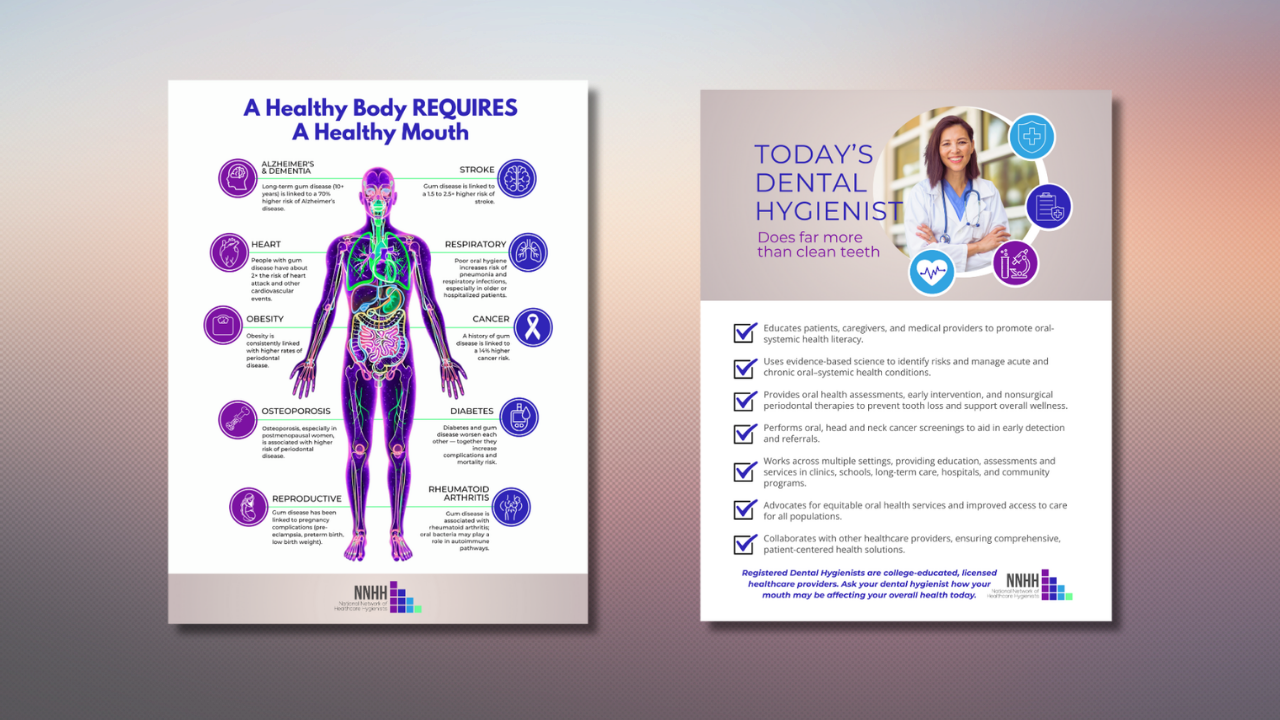
Scientific evidence continues to reinforce that oral health and systemic health are interconnected. Periodontal inflammation has been linked to systemic inflammatory burden and cardiovascular disease (Tonetti & Van Dyke, 2013).³ When breathing is compromised during sleep, oxygen fluctuations and inflammatory stress can further affect the body’s cardiovascular and metabolic systems.
This reinforces an important truth: the mouth is not separate from the body. It is part of it.
Registered Dental Hygienists are trained to recognize these connections. We review your medical history, assess your risk factors, monitor changes over time, and provide education tailored to your overall health profile.
What Your RDH May Be Evaluating
During your appointment, your hygienist may assess:
-
Dental arch development
-
Signs of mouth breathing
-
Soft tissue inflammation
-
Clenching or grinding patterns
-
Gum health and bone stability
-
Risk indicators for sleep-disordered breathing
Research has shown that tongue and throat exercises (often incorporated in myofunctional therapy) can reduce apnea severity in certain patients (Camacho et al., 2015).⁴ This highlights the important role of oral muscle function in airway stability.
These observations are not about diagnosing medical conditions — they are about recognizing patterns and helping you understand how oral function may relate to how you feel every day.
Prevention Starts with Awareness
Because hygienists see patients regularly — often twice a year or more — we are in a unique position to notice gradual changes that might otherwise go unrecognized. Early conversations about breathing, sleep quality, and oral function can lead to timely collaboration with other healthcare providers when needed.
Your Registered Dental Hygienist plays a crucial role in protecting not just your smile, but your airway, your sleep, and your long-term health. If you have concerns about snoring, fatigue, grinding, or mouth breathing, start the conversation at your next visit. Prevention begins with understanding — and your RDH is an essential partner in your whole-body wellness.
3 Questions to Ask Your Dental Hygienist about Yourself, (or Your Child):
-
Do you see any signs that I may be mouth breathing?
-
What grade are my tonsils?
-
Do you notice signs of clenching or grinding in my mouth?
Starting the conversation is the first step toward proactive, whole-body health. Yes to any of these may warrant futher investigation with a myofunctional therapist, ENT and sleep physician.
Learn more about signs of airway dysfunction and share with you registered dental hygienist here
References
-
Somers VK, White DP, Amin R, et al. Sleep apnea and cardiovascular disease. Journal of the American College of Cardiology. 2008;52(8):686–717.
-
Pamidi S, Tasali E. Obstructive sleep apnea and type 2 diabetes: Is there a link? Frontiers in Neurology. 2012;3:126.
-
Tonetti MS, Van Dyke TE. Periodontitis and atherosclerotic cardiovascular disease. Journal of Clinical Periodontology. 2013;40(S14):S24–S29.
-
Camacho M, Certal V, Abdullatif J, et al. Myofunctional therapy to treat obstructive sleep apnea: A systematic review and meta-analysis. Sleep. 2015;38(5):669–675.
About the Author

Tamara Thomas, RDH, CSOM, CH-OSE is a Registered Dental Hygienist and Certified Specialist in Orofacial Myology with a deep passion for advancing oral and systemic health. As the owner of Facial Physique Orofacial Myofunctional Therapy, she focuses on supporting optimal breathing and craniofacial development for both children and adults. Tamara previously served as a mentor with Airway Circle’s foundational and advanced myofunctional therapy programs and has been a speaker for the STAR course, promoting interdisciplinary collaboration in sleep, airway, and tethered oral tissue education. She is an instructor and certificate holder in the accredited Oral Systemic Educator Certificate Program™ and currently serves as President of the National Network of Healthcare Hygienists, where she advocates for elevating the role of the RDH in whole-body healthcare. Through education, leadership, and patient-centered care, Tamara is committed to empowering hygienists and helping families understand the powerful connection between oral health and overall wellness. Connect with her at [email protected]