A Letter from Our Founder, Jamie Dooley
Apr 29, 2026In 2018, NNHH was born from a pattern I kept seeing and could no longer ignore. While working with hundreds of hygienists, I noticed they were taking more CE credit hours than required, staying up all night reading other profession's journals, and strategizing innovation — yet when they tried to suggest improvements to office protocols, or collaborate with other providers, they were dismissed. The phrase I heard most often was this: "If I had a credential they recognized, I think they would actually listen to me."
That one sentence became the foundation of everything we have built. Eight years later, they are listening.
Welcoming Our Incoming Board President
Before we look at how far we have come, I want to thank our entire leadership team. Every member of our Board of Directors and Advisory Group who has stepped forward and led has been pivotal to our success. I'd like to officially welcome Tamara Thomas as our incoming Board Chair for 2026/27. Tamara's commitment to elevating the public's understanding of what dental hygienists actually do — our education, our scope, our preventive expertise — is exactly what this moment calls for. Read her full message to the NNHH community HERE.
Reclaiming Our Identity
Tamara and I are in full agreement that for far too long, our profession has been handed a narrow identity. The message, spoken or simply assumed, was that our value was limited to the operatory — that our only worth was with a scaler in our hands. As my carpal tunnel wrists type this, I just received a text from another scared hygienist headed for elbow surgery. We have damaged our bodies for the sake of a paycheck, yet we are capable of so much more.
I am 12 years out of clinical care, and I am certain I am having a greater impact on the oral-systemic health of our nation doing this work than I ever did in private practice. Tamara has a full-time myofunctional therapy business that requires daily collaboration with multidisciplinary providers. Neither of us holds a traditional clinical role, yet we are deeply satisfied with being an RDH. We designed an expanded identity for ourselves first, then took action in alignment with it.
Expanding Our Role
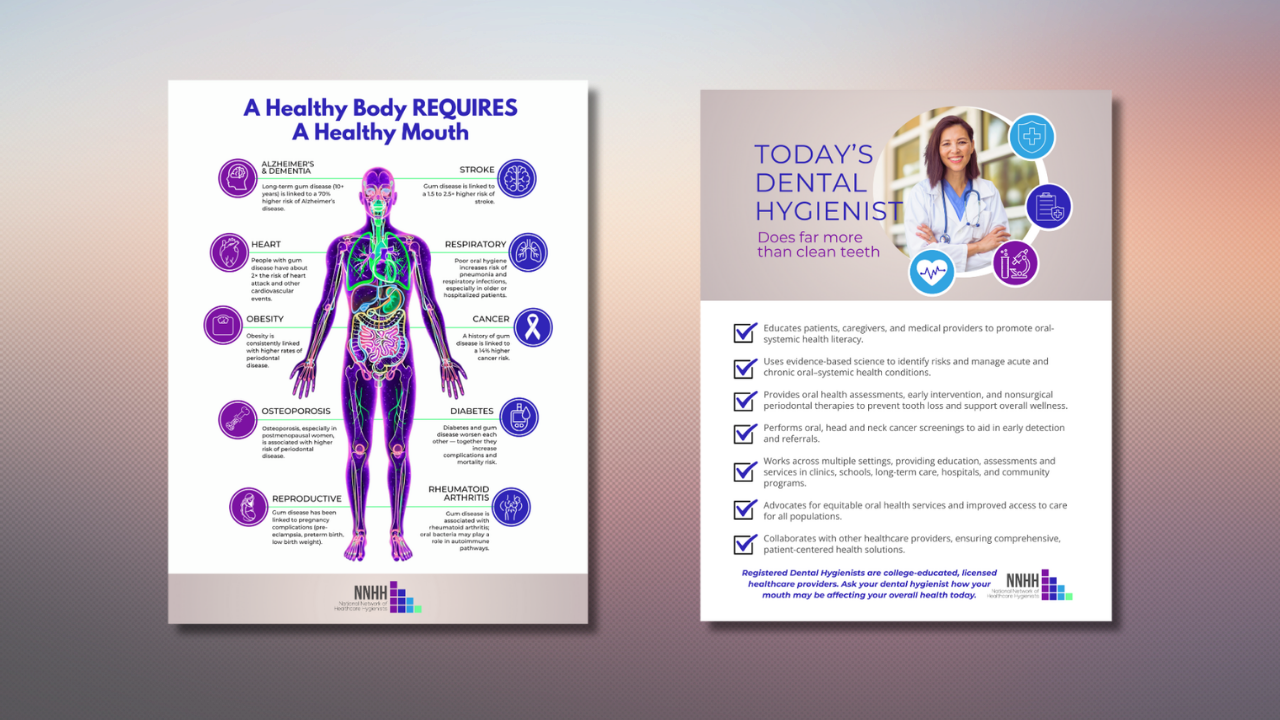
Dental hygienists bring broad skills to the healthcare landscape — oral health protocol development, curriculum design, project management, comprehensive assessments, risk stratification, and patient and provider education — with a deep understanding of the oral-systemic chronic disease states that most practitioners are ignoring — not out of neglect, but out of lack of education.
Hospitals and healthcare systems recognize that an oral health expert and coordinator is an essential starting point, creating a clear opportunity for a trained professional to fill a role their current provider teams are not equipped to cover. What NNHH has been doing since 2018 — through member services, resource sharing, and workforce development — is preparing hygienists to share their expertise with healthcare systems. Our students are educating their local medical providers on oral-systemic health as a requirement of their capstone projects, which has been a catalyst for many of them getting a seat at the leadership table; where their voice is not just heard, but valued.
The Barriers Are Real — So Is the Reason I Keep Going
Integration has moved slowly for structural and financial reasons. Oral health continues to be left out of the referral system, and the reasons are not always accidental. After working with other professionals who have attempted to integrate oral health into large healthcare systems, I have found out that some healthcare administrators fear that addressing oral-systemic disease may decrese long-term revenue tied to managing chronic conditions. Those systems will be the last to integrate us. The systems that place people above profits are already hiring hygienists — and as they demonstrate reductions in hospital-acquired infections, all-cause mortality, costs, and length of stay, they will publish that data and present it at conferences. That is how change spreads in healthcare. When the right systems lead, the rest will follow.
As a mom of a daughter with multiple special needs, I see the disconnection firsthand every week as her case manager. It is not just that oral health is being left out; it is that the more specialized providers become, the less they understand the connections and correlations that real people are suffering from. Systemic innovation is needed to bring all providers back to seeing whole people, not parts.
Members and Students Stepping Into Dream Roles
NNHH is funded by our membership dues and program tuition, so thank you to our entire community for believing in this mission. You are the best part of NNHH! Watching you land promotions and dream roles has been one of the greatest rewards of this journey. The right training and mentorship can be far more individualized to the needs of a role than a degree program. Hygienists are now stepping into hospital roles, oncology care teams, community health settings, and administrative leadership — directing teams of integrated hygienists in pathways that have been commonplace for nurses for decades. Many will eventually pursue advanced degrees, with their systems funding and supporting that growth.
The CE Landscape and NNHH's Accreditation Standard
Integration has not been without barriers — training and language gaps, scope of practice limitations shaped by a profession with a conflict of interest in governing us, and a CE landscape long dominated by product companies and corporate interests. AGD PACE and ADA CERP approve CE providers, not individual programs, which has allowed commercially influenced content to carry the appearance of professional credentialing. Traditional dental CE was never designed to expand our potential or prepare us for roles beyond the operatory. If we want to be seen as the healthcare providers we are, we have to go above and beyond license renewal. NNHH was built for workforce expansion with research-based, unsponsored, unbiased programs built on the global ASTM E2659 standard for certificate programs and third-party accredited by ANSI National Accreditation Board (ANAB) — an organization the medical world already knows and trusts.
The 2028 Vision: Formal Post-Licensure Credentialing
The vision we are holding for 2028 is formal post-licensure credentialing for registered dental hygienists working in healthcare systems as a recognized, standardized national pathway. A job task analysis is underway and competencies are being defined. Systems across the US and beyond now have at least one RDH on staff. It has been wonderful to watch it unfold. What we are still missing is a formal credential, built on ISO/IEC 17024 guidelines, that makes it a professional standard. Every allied partnership we secure is a step toward that.
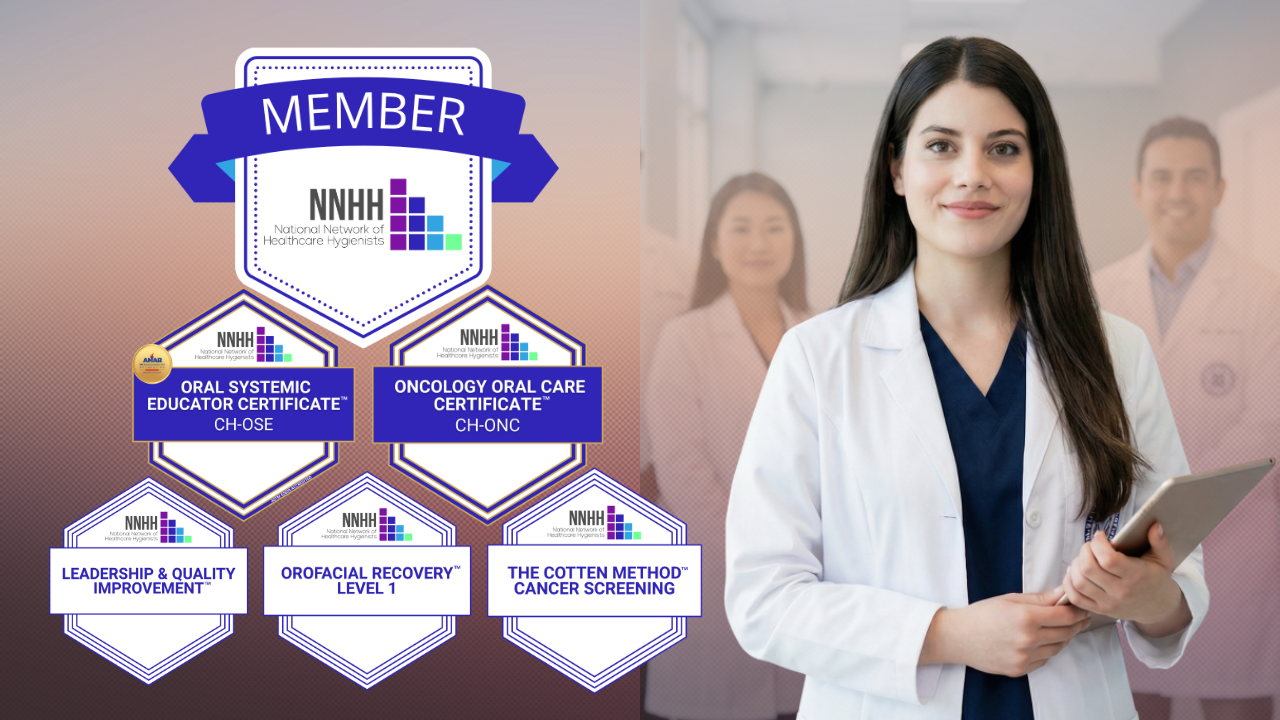
To take a step toward this vision, I am excited to announce that NNHH has added digital badges to all credentials this month, powered by Accredible. Included with tuition, each certificate holder receives a digital wallet where they can securely collect, organize, and share their NNHH badges and other professional credentials, making post-license education easier to verify and present in both dental and medical settings. This helps remove a long-standing barrier: many healthcare teams and administrators do not yet have a clear way to recognize the depth of education, competence, and clinical value RDHs bring to integrated care.
Investing in Yourself
Rethink what it means to invest in yourself. Most hygienists think of professional spending as the CE they are required to get. While that maintains your license, it does little (if anything) for career expansion. The investments that actually move you forward are the ones you choose: professional associations, targeted training, and mentorship aligned with where you want to go. Dedicate 5 percent of your hygiene income to those — above and beyond the number of dental CE credits you are required to take. Seek out environments that align with what you know is best for you and your patients. Be a forward thinker, and look for healthcare innovation that includes us. Change happens when we step into our full value and take ownership of our abilities as equal partners in overall healthcare.
A Call to Lead
Leaders are molded by challenge and polished by grace. To the healthcare-based hygienists who have spent hours on Zoom with me, guided our curriculum development, taught in our programs, performed peer reviews, and advised our board — please know how grateful I am for you and your leadership. NNHH would not exist without your willingness to take imperfect action, learn "by firehose," and share your knowledge gracefully. We can only rise when we do so together. You are who I model myself after every day. When imposter syndrome creeps in, I remember your challenges and I pick myself back up. I do this for you, and for all the patients we have not been able to serve — those who may have died on paper from a heart attack or stroke, but whose untreated periodontal disease was the engine feeding the inflammatory fire.
We are all called to lead something, somewhere in our lives. If you are reading this today, it is your sign to trust your intuition and act on that small, still voice that calls from your heart — just as the pioneers of these roles did decades ago. Many of us carry the neurological imprint of workplace trauma — chronic stress, diminished confidence, and a nervous system conditioned to shrink — and it is important to name it, because that imprint is not a character flaw; it is a physiological response to an environment that was never designed to honor our full capacity. I know many of you are thinking, "Maybe this is just the best it gets." I promise you that if you hold on a little longer, expanded career pathways will be open for you. The fastest way to get there is to create one for yourself, now.
The Power of Your Heart in Career Expansion and Enjoyment
I understand why so many of you do not feel like a leader. We have all been bullied or belittled at some point in our lives. We can let those incidents hold us back, or we can remind ourselves that "hurt people hurt people," send everyone love (including ourselves), and take small actions each day that align with the future we want to live in. One where we forgive each other and work together. A future based on collaboration, not competition.
As a trauma-informed coach, I can tell you from my own experience — and from the hundreds of hygienists I have had the privilege of mentoring over the years — that when you learn to listen to your heart over the noise of your thoughts, everything shifts. An open heart holds wisdom that your mind will always try to talk you out of. It knows your purpose before you can articulate it. It knows when to stay and when to go. It knows what you are worth. When you begin to lead from that place, you will not just enjoy your career — you will enjoy your life again.
This is no longer a pipe dream. We are here. This is the year of the RDH!
Jamie Dooley, BIS, RDH, CWDP
Founder & Program Director
National Network of Healthcare Hygienists